Route overview and landmarks of the 2026 Paris Half Marathon
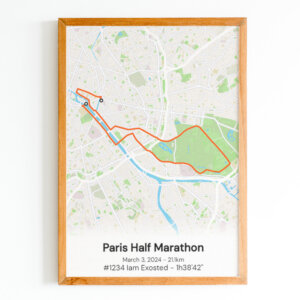
The Paris Half Marathon course traces a large loop through the east and centre of the French capital. It alternates between lively city streets, the banks of the Seine and a green escape through the Bois de Vincennes — a genuine guided tour of Paris’s most iconic landmarks.
Start to the Bibliothèque François-Mitterrand (km 0–3)
The start line is set on Boulevard Saint-Germain, a wide avenue that gives runners plenty of room to find their stride from the very first steps. The route passes the Institut du Monde Arabe and the Jardin des Plantes before joining the Quai d’Austerlitz along the Seine heading east. The imposing Bibliothèque François-Mitterrand marks the approach to km 2, followed by a sharp 90-degree turn onto the Pont de Tolbiac.
Heading towards the Bois de Vincennes (km 3–7)
A second 90-degree turn takes runners onto the Rue de Charenton, where the first aid station at km 5 offers both food and drink. By this point the field has spread out comfortably. Runners then begin the gentle climb towards the entrance of the Bois de Vincennes, where the tree cover provides a welcome coolness in early March.
The Bois de Vincennes: the heart of the course (km 7–12)
This is the most technically demanding stretch of the race. The paths of the Bois de Vincennes feature light rolling terrain that tests the legs differently from flat city tarmac. A second aid station is available at km 9. Around km 10–11, runners pass in front of the magnificent Château de Vincennes, home to the official Hoka Cheering Zone — a real boost when you need it most. A brief stretch alongside the Paris Zoo leads towards the Accor Arena as the wooded section draws to a close.
Back to the Seine and the final push (km 12–21.1)
The exit from the Bois eases runners gradually back into the urban environment. Boulevard de Bercy hosts an electrolyte station at km 15 and a full food and drink aid station at km 16. Runners then rejoin the banks of the Seine, passing alongside the Île Saint-Louis with crowds cheering from the sidelines. Rue de Rivoli at km 18 is wide, flat and buzzing — the perfect place to shift up a gear. Rue Saint-Antoine leads straight to the finish line at Place de la Bastille.
Mile-by-mile breakdown of the Paris Half Marathon
| Section |
Landmarks & key points |
Terrain |
| 0–1 km |
Start on Boulevard Saint-Germain – Institut du Monde Arabe – Jardin des Plantes |
Flat |
| 1–3 km |
Quai d’Austerlitz – Bibliothèque François-Mitterrand – Pont de Tolbiac |
Flat |
| 3–5 km |
Rue de Charenton – Aid station km 5 (food & drink) |
Flat |
| 5–7 km |
Entrance to Bois de Vincennes – shaded woodland paths |
Gentle uphill |
| 7–10 km |
Forest paths – light undulations – Aid station km 9 |
Rolling |
| 10–12 km |
Château de Vincennes – Hoka Cheering Zone – Paris Zoo |
Slightly undulating |
| 12–15 km |
Exit Bois de Vincennes – Accor Arena – Electrolytes km 15 |
Gentle downhill |
| 15–17 km |
Boulevard de Bercy – Aid station km 16 (food & drink) |
Flat |
| 17–18 km |
Banks of the Seine – large crowds |
Flat |
| 18–20 km |
Île Saint-Louis – Quai des Célestins – Rue de Rivoli |
Flat |
| 20–21.1 km |
Rue Saint-Antoine – Finish at Place de la Bastille |
Flat |
Elevation profile
With just 80 metres of cumulative elevation gain, the Paris Half Marathon ranks among the fastest courses in mainland France. For context, the Lyon Half Marathon features more than 200 metres of positive elevation.
The route begins at roughly 28 metres above sea level on the riverside quays, dips slightly to 24–25 metres near the Bibliothèque François-Mitterrand, then climbs gradually to 40–42 metres through the higher sections of the Bois de Vincennes (km 10–11). After the Château de Vincennes, the course descends gently back to the quayside (24 m) and remains essentially flat all the way to the Bastille.
Watch out: The rolling terrain inside the Bois de Vincennes (km 5 to 12) is deceptively demanding. The inclines feel manageable in isolation, but their cumulative effect on your legs can be significant. Keeping your effort in check through this section is the single biggest factor in running a strong second half.
Race strategy for the 2026 Paris Half Marathon
The layout of the Paris Half Marathon course lends itself perfectly to a negative split strategy: start slightly below your target pace and build progressively once you exit the Bois de Vincennes.
Managing the start
The energy on Boulevard Saint-Germain at the gun is electric — and that is precisely the danger. Getting swept up in the early excitement is the most common mistake on this course. Seeding yourself in the right corral and sticking to your planned pace from the very first kilometre will pay dividends over the final miles.
Tackling the Bois de Vincennes
From km 5 onwards, focus on maintaining a high cadence rather than lengthening your stride to absorb the rolling terrain without burning through your reserves. Do not skip the aid station at km 9, even if you feel strong — your legs in the closing kilometres will thank you for it.
Finishing strong on the Rue de Rivoli
Clearing the Bois at km 12 signals a return to flat city streets all the way to the finish. This is your cue to gradually wind up the pace. Rue de Rivoli at km 18 is your launchpad: it is wide, flat and lined with cheering spectators — the ideal stretch to empty the tank over the final 3 kilometres to the Bastille.
Practical information: logistics, transport and start corrals
Getting there by public transport
- Start (Boulevard Saint-Germain): Métro Jussieu (lines 7 and 10) or Métro Cardinal Lemoine (line 10)
- Finish (Bastille): Métro Bastille (lines 1, 5 and 8) or RER A from Gare de Lyon
- Driving is strongly discouraged due to widespread road closures on race day
- Vélib’ hire bikes are a practical option for reaching the start from central arrondissements
Race village and bib collection
- Race village: Place de la Bastille
- Bib collection: dates and times to be confirmed on the official website hokasemideparis.fr
- Exhibitors, entertainment and live music are all part of the village programme
Start corral structure
- Wheelchair / para-athletics corral
- Elite corral
- Priority corrals 1 and 2
- Corrals for 1:30 / 1:35 / 1:40 / 1:45 / 1:50 target times
- Corrals for 2:00 / 2:10 and slower
FAQ — 2026 Paris Half Marathon
Where does the 2026 Paris Half Marathon start?
The race starts on Boulevard Saint-Germain (5th arrondissement), close to the Pont de Sully. Runners are assigned to corrals according to their target finishing time. The official start time for the first wave is 7:58 AM on Sunday 8 March 2026.
Where does the 2026 Paris Half Marathon finish?
The finish line is at Place de la Bastille (12th arrondissement). The race village — bib collection, exhibitors and post-race entertainment — is also located on this iconic square.
What is the elevation gain on the 2026 Paris Half Marathon?
The course has a cumulative elevation gain of approximately 80 metres and a total descent of 155 metres. The only notable undulation is found in the Bois de Vincennes, between kilometres 5 and 12. It is one of the flattest half marathon courses in France.
How many aid stations are on the course?
There are 4 aid stations on the 2026 Paris Half Marathon: food and drink at km 5 (Rue de Charenton), food and drink at km 9 (Bois de Vincennes), lemon-flavoured electrolytes at km 15, and food and drink at km 16 (Boulevard de Bercy). A final aid station is available at the finish line.
Where can I download the GPX file for the 2026 Paris Half Marathon?
The official GPX track is available on WeRun (login required) and on the official website hokasemideparis.fr. A direct download is also provided in this article, compatible with all GPS devices (Garmin, Suunto, Polar, Coros, Wahoo) and running apps (Strava, Komoot).
Is the Paris Half Marathon a fast course?
Absolutely. With just 80 metres of elevation gain, the course is widely considered flat and fast. The men’s course record is 1:00:16, set by Kennedy Kimutai in 2025. It is an excellent race for targeting a personal best, provided you manage the rolling Vincennes section carefully.
How many runners take part in the Paris Half Marathon?
The 2026 edition expects more than 45,000 runners, confirming its status as the largest half marathon in France. The 2025 race welcomed 48,000 participants.
Conclusion
The 2026 Paris Half Marathon course is a truly unique experience, blending competitive running with an unforgettable tour of the French capital. From the banks of the Seine to the Bois de Vincennes, past the Château de Vincennes and along the Rue de Rivoli, these 21.097 kilometres offer equal measures of beauty and challenge. With its largely flat profile, four well-placed aid stations and organised corral system, the race gives every runner the conditions they need to run their best.
Download the GPX file above to load the route onto your GPS watch and visualise every section before race day. Good luck on 8 March 2026!