Whether you are chasing a precise goal time or simply the finish line of your first race, this marathon pace chart starts from one certainty: pace is the key to not blowing up before km 35.
But how do you know if you should run 6 minutes, 6 minutes 30 or 7 minutes per kilometer? And above all, how do you hold it for 42.195 km, even when your legs feel heavy and doubt creeps in?

👉 Here you will find an interactive marathon pace calculator: choose your goal time and it works out your pace per km and your split times every 5 km. You will also find ready-to-use charts for 5 classic goal times (from 3h to 5h), tips for using them before and during the race, and an idea to turn your finish time into a printed keepsake.
🧭 What is a marathon pace chart for?
Understanding pace: min/km, km/h, split times
Your pace is the time it takes you to cover 1 kilometer, expressed in min/km. A pace of 6:00 min/km means you run each kilometer in 6 minutes. Speed (in km/h) is the equivalent, more common among cyclists.
Split times tell you when you should reach the key points (5 km, 10 km, half marathon…) if you stick to your planned pace. A pace chart brings these three benchmarks together.
Why visualizing your pace helps you run a better race
A marathon is above all an exercise in managing effort over time. Go out too fast and you risk hitting the wall at km 30. Go too slow and you finish frustrated. The chart becomes your compass: it helps you hold a steady rhythm, adjust on the go and anticipate the key moments.
Planning your pace to avoid blowing up
Marathoners who blow up rarely do so for lack of training, but because they mismanaged their pace. The chart tells you whether you are ahead or behind, and whether to slow down, hold steady or push.
💡 Tip: print your chart and slip it into your running belt, or stick it on your watch.
Marathon pace calculator for your goal time
Drag the slider to choose your finish time, from 2h00 to 7h00.
Average pace: 5:41 /km
Split times every 5 km
Marathon pace chart (from 2h00 to 7h00)
| Marathon time | Pace (min/km) | Speed (km/h) |
|---|---|---|
| 2h00 | 2:51 | 21.1 |
| 2h05 | 2:58 | 20.3 |
| 2h10 | 3:05 | 19.5 |
| 2h15 | 3:12 | 18.8 |
| 2h20 | 3:19 | 18.1 |
| 2h25 | 3:26 | 17.5 |
| 2h30 | 3:33 | 16.9 |
| 2h35 | 3:40 | 16.3 |
| 2h40 | 3:48 | 15.8 |
| 2h45 | 3:55 | 15.3 |
| 2h50 | 4:02 | 14.9 |
| 2h55 | 4:09 | 14.5 |
| 3h00 | 4:16 | 14.1 |
| 3h05 | 4:23 | 13.7 |
| 3h10 | 4:30 | 13.3 |
| 3h15 | 4:37 | 13.0 |
| 3h20 | 4:44 | 12.7 |
| 3h25 | 4:52 | 12.3 |
| 3h30 | 4:59 | 12.1 |
| 3h35 | 5:06 | 11.8 |
| 3h40 | 5:13 | 11.5 |
| 3h45 | 5:20 | 11.3 |
| 3h50 | 5:27 | 11.0 |
| 3h55 | 5:34 | 10.8 |
| 4h00 | 5:41 | 10.5 |
| 4h05 | 5:48 | 10.3 |
| 4h10 | 5:55 | 10.1 |
| 4h15 | 6:03 | 9.9 |
| 4h20 | 6:10 | 9.7 |
| 4h25 | 6:17 | 9.6 |
| 4h30 | 6:24 | 9.4 |
| 4h35 | 6:31 | 9.2 |
| 4h40 | 6:38 | 9.0 |
| 4h45 | 6:45 | 8.9 |
| 4h50 | 6:52 | 8.7 |
| 4h55 | 6:59 | 8.6 |
| 5h00 | 7:07 | 8.4 |
| 5h05 | 7:14 | 8.3 |
| 5h10 | 7:21 | 8.2 |
| 5h15 | 7:28 | 8.0 |
| 5h20 | 7:35 | 7.9 |
| 5h25 | 7:42 | 7.8 |
| 5h30 | 7:49 | 7.7 |
| 5h35 | 7:56 | 7.6 |
| 5h40 | 8:03 | 7.4 |
| 5h45 | 8:11 | 7.3 |
| 5h50 | 8:18 | 7.2 |
| 5h55 | 8:25 | 7.1 |
| 6h00 | 8:32 | 7.0 |
| 6h05 | 8:39 | 6.9 |
| 6h10 | 8:46 | 6.8 |
| 6h15 | 8:53 | 6.8 |
| 6h20 | 9:00 | 6.7 |
| 6h25 | 9:07 | 6.6 |
| 6h30 | 9:15 | 6.5 |
| 6h35 | 9:22 | 6.4 |
| 6h40 | 9:29 | 6.3 |
| 6h45 | 9:36 | 6.3 |
| 6h50 | 9:43 | 6.2 |
| 6h55 | 9:50 | 6.1 |
| 7h00 | 9:57 | 6.0 |
📊 Pace charts for 5 classic goal times
Know roughly what time you want to finish in? These charts show your target rhythm as pace (min/km), speed (km/h) and split times at the main checkpoints. Print them or snap a photo for race day.
🎯 Marathon goal: 5h00 (pace 7:07/km, speed 8.4 km/h)
| Distance | Split time |
|---|---|
| 5 km | 35:33 |
| 10 km | 1:11:06 |
| 15 km | 1:46:39 |
| 20 km | 2:22:12 |
| Half | 2:30:00 |
| 25 km | 2:57:45 |
| 30 km | 3:33:18 |
| 35 km | 4:08:51 |
| 40 km | 4:44:24 |
| 42.195 km | 5:00:00 |
🎯 Marathon goal: 4h30 (pace 6:24/km, speed 9.4 km/h)
| Distance | Split time |
|---|---|
| 5 km | 32:00 |
| 10 km | 1:03:59 |
| 15 km | 1:35:59 |
| 20 km | 2:07:59 |
| Half | 2:15:00 |
| 25 km | 2:39:58 |
| 30 km | 3:11:58 |
| 35 km | 3:43:58 |
| 40 km | 4:15:57 |
| 42.195 km | 4:30:00 |
🎯 Marathon goal: 4h00 (pace 5:41/km, speed 10.5 km/h)
| Distance | Split time |
|---|---|
| 5 km | 28:26 |
| 10 km | 56:53 |
| 15 km | 1:25:19 |
| 20 km | 1:53:45 |
| Half | 2:00:00 |
| 25 km | 2:22:12 |
| 30 km | 2:50:38 |
| 35 km | 3:19:05 |
| 40 km | 3:47:31 |
| 42.195 km | 4:00:00 |
🎯 Marathon goal: 3h30 (pace 4:59/km, speed 12.1 km/h)
| Distance | Split time |
|---|---|
| 5 km | 24:53 |
| 10 km | 49:46 |
| 15 km | 1:14:39 |
| 20 km | 1:39:32 |
| Half | 1:45:00 |
| 25 km | 2:04:25 |
| 30 km | 2:29:18 |
| 35 km | 2:54:11 |
| 40 km | 3:19:05 |
| 42.195 km | 3:30:00 |
🎯 Marathon goal: 3h00 (pace 4:16/km, speed 14.1 km/h)
| Distance | Split time |
|---|---|
| 5 km | 21:20 |
| 10 km | 42:40 |
| 15 km | 1:03:59 |
| 20 km | 1:25:19 |
| Half | 1:30:00 |
| 25 km | 1:46:39 |
| 30 km | 2:07:59 |
| 35 km | 2:29:18 |
| 40 km | 2:50:38 |
| 42.195 km | 3:00:00 |
To aim for 4h15 or 3h45, interpolate between two charts or use the calculator. To structure your training, also check out this free marathon training plan or our guide to preparing for your first marathon.
🎯 How to use these charts before and during the race
Before the race: make your pace your own
A pace chart is not just something to slip into a pocket on race day. It is most useful in the weeks before. If you are aiming for 4h30, that means 6:24/km for more than four hours. After a few long runs at that pace, your body recognizes it: it becomes a feeling, not just a number.
A half marathon run during your build-up is a good benchmark: roughly double your time, add a few minutes, and you can check whether your goal is realistic.
Race day: resist the start-line adrenaline
The biggest marathon trap is the first kilometer. The atmosphere, the crowd and the excitement push you to start faster than planned, often without you noticing. Checking your split time every 5 km is enough: if you are slightly ahead, ease off now, not at km 35.
The halfway point is often the turning point. With a few minutes in hand and good legs, change nothing. If you are already at your limit, take it as a warning sign.
Adapting when things don’t go to plan
Unusual heat, a hillier course than advertised, a restless night: a race never unfolds exactly as planned. It is better to adjust your pace and listen to how you feel than to fight for a time. A marathon finished cleanly beats a DNF at km 38.
💡 Write your key split times on a small piece of paper tucked into your belt, or on your forearm with a marker. A few checks at the kilometer markers are enough.
⌚ Current pace, average pace, split times: which one to follow?
Current pace is the least reliable figure. The GPS signal fluctuates, especially in town: your display can jump from 5:40 to 6:10/km in a few seconds without your rhythm changing.
Average pace is more useful, but it smooths everything out: a too-fast start can hide a gradual fade.
The most reliable remains the clock at the kilometer markers. Compare your actual split time with the chart and you know immediately where you stand.
🖼️ And after the race?
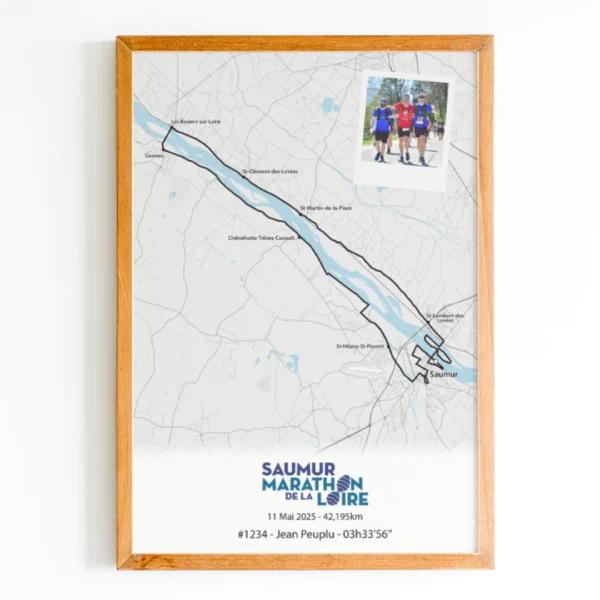
After a marathon, everything fades fast: the phone photos, the crumpled bib at the bottom of a bag, and life goes on. That is exactly why The Post Trace exists: to turn your GPS trace, your exact route and your time into a custom printed poster that tells the story of your race, not a generic photo of the event.
You personalize the title, the details, the format and the material. For a first marathon or a tenth, it is a way to keep a trace of what you went through, and a gift that means something to a runner friend.
 Custom Running Poster
 Paris: My First Marathon
 Marathon de La Rochelle Poster
 Marathon de la Loire Poster
Marathon pace FAQ
What pace do you need to run a 4-hour marathon?
To finish a marathon in 4 hours, you need to hold a pace of 5:41 min/km, or about 10.5 km/h. It is within reach for a regular runner with a few months of training. The ideal is to test it on long runs of 25 to 30 km before race day.
How do you calculate your marathon pace?
Divide your goal time (in minutes) by the distance (42.195 km). For 3h30 (210 minutes): 210 ÷ 42.195 = 4.98 min/km, or about 4:59 /km. The calculator above gives you your pace and split times directly.
What is the average pace of a marathon finisher?
In France, the average marathon finish time is around 4h30 to 4h45, a pace between 6:24 and 6:45 min/km. These figures vary with the level of the race and the course profile.
What pace should you choose for a first marathon?
For a first marathon, the number one goal is to finish without blowing up. It is better to aim for a cautious pace, often 30 to 60 seconds per km slower than you think you can hold, and speed up if you feel good after km 30. A pace between 6:00 and 7:00 min/km is often recommended for beginners.
Why do runners blow up at km 30 of a marathon?
The “marathon wall” hits when muscle glycogen stores run out, usually between km 30 and km 35. Your pace then drops sharply. The main cause is not a lack of fitness but a start that was too fast: 5 to 10 seconds too many per kilometer can be enough.
Should you run an even pace or speed up at the end?
Both strategies work, but the safest one, especially for non-elite runners, is to run an even pace, or even a negative split (second half faster than the first). Starting too fast remains the most common and most costly mistake.
More guides to read
• Race pace chart and split times (5K, 10K, half marathon)
• How long does it take to prepare for a marathon?
• Marathon nutrition, 7 days out: the full plan
• Top 30 most beautiful marathons in the world


